
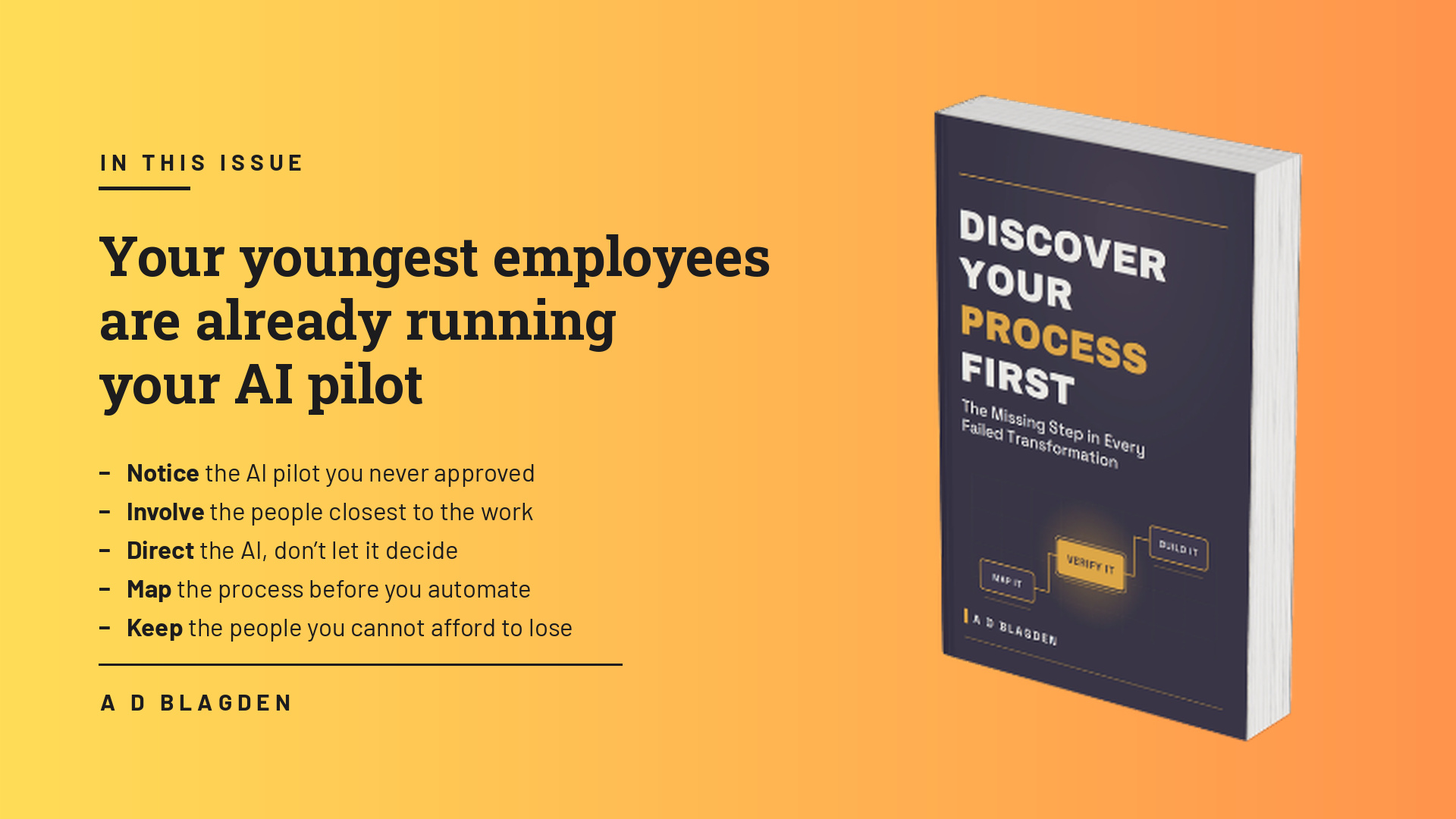
Your Youngest Employees Are Already Running Your AI Pilot
Nobody authorised it. Nobody scoped it. It is happening anyway.
When I was researching Discover Your Process First:The Missing Step in Every Failed Transformation, I interviewed four people at the beginning of their careers — an undergraduate, a PhD researcher, a civil servant and a placement student in ethical banking. I expected to learn something about motivation. What I also got was an unplanned report on how artificial intelligence is actually being adopted inside organisations.
Not through a programme. Through individuals, quietly, one task at a time.
There are two threads in this book that most people treat separately. They belong together.
Thread one: Gen Z is not the problem you think it is
The received wisdom says this generation is impatient, distracted and disloyal. My interviews said something different and more useful.
They are fluent with technology, but fluency is not the same as enthusiasm. The same person who reaches instinctively for an AI tool to solve a practical problem will also object, on principle, to software that tracks their inactivity and warns them about productivity. One interviewee drew that line immediately. He did not want someone controlling his every move.
Their loyalty is conditional rather than absent. It holds where there is purpose, decent people, visible progression and flexibility. Remove those and they leave — not out of fickleness, but because stagnation reads to them as risk.
And they do not want to be trained on tools chosen by someone else. They want a hand in deciding how those tools are used. That single point is where the chapter on engaging Gen Z stops being a management topic and becomes a transformation topic.
There is a warning in the research too. One interviewee, working in a lab where technology has raised expectations rather than lowered them, described emails going out at nine in the evening and arriving at midnight. The tools had extended her working day without anyone consciously agreeing to it. Efficiency that simply creates unmanaged workload is not a win.
Thread two: AI magnifies whatever you give it
Here is the line from the book I keep coming back to. AI does not remove ambiguity. It magnifies it.
Point a capable model at a process nobody has ever mapped, and you get fast, confident, well-formatted output built on assumptions no one has checked. The speed is real. So is the error.
I think there will be two kinds of people interacting with AI: those who direct it towards what they want, and those who let it decide for them. I call the first approach Directed-AI. Discover your process first, then use AI as an accelerator — not a substitute.
That is not a philosophical position. It is a sequencing one. Once a workflow is genuinely mapped, it can be verified — the Verification Engine™ inside Agile Discovery™ turns a mapped workflow into a testable model before anyone writes code or buys a licence. Direction comes from clarity about the process. Nothing else supplies it.
Where the two threads meet
Your youngest employees are running the experiment already. They are using AI on the parts of their jobs they find tedious, choosing their own tools, and forming their own view of what the technology should and should not be allowed to do.
That is Directed-AI happening at the level of the individual, in the dark, with no shared map underneath it.
Two things follow.
The first is that these are the people best placed to help you map the process, because they are closest to the work and they have already been experimenting with it. Involve them in the discovery and you get better maps and a motivated cohort in the same move.
The second is that if you skip discovery, AI will not save the transformation. It will simply help you build the wrong thing faster, and the people you most needed to keep will watch you do it.
Don’t automate chaos.
Discover Your Process First: The Missing Step in Every Failed Transformation is currently in presale.
If you manage people at the start of their careers, Chapters 13 and 14 tell you what the research actually found and Appendix C gives you the steps to act on it. If you are at the start of your career, the rest of the book gives you something more useful — the method your employer is missing, and the language to argue for it before the next transformation lands on you.
Discover your process first. Everything else follows.
Back the campaign and reserve your copy.
This book argues against building anything before you have asked the people who will use it. Backers will receive a signed first edition, while Inner Circle supporters will also have their name included in the acknowledgments and receive a complimentary Technology Q&A Webinar valued at $200. (All prices are in USD.)
Even when pledging is not possible, sharing the campaign with one relevant person would make a real difference.
Thank you for following the journey and helping me bring Discover Your Process First to a wider audience.
Subscribe to my LinkedIn newsletter How SME's Can Go Digital!
David Blagden © 2026
#DigitalTransformation #ProcessDiscovery #AI #DiscoverYourProcessFirst